Planar Patch
A planar patch is a finite-thickness ellipse or rectangle lying in an arbitrary plane. Control volumes that intersect the patch are assigned to the region. The corresponding input card is PLANAR_PATCH.
Geometric definition
Let \(\mathbf{c}\) be the patch centroid, \(\mathbf{n}\) a unit normal to the plane, and \((\hat{\mathbf{e}}_1,\hat{\mathbf{e}}_2)\) an orthonormal basis in the plane with \(\hat{\mathbf{e}}_2 = \mathbf{n}\times\hat{\mathbf{e}}_1\). In-plane coordinates of a point \(\mathbf{x}\) are
The patch of half-thickness \(h>0\) and semi-axes \(a,b\) is the set of points satisfying
The first condition is a slab about the plane; the second is the in-plane shape. Together they define a finite-aperture disk (or panel), not an infinite plane.
Orientation
Two equivalent specifications of \((\mathbf{n},\hat{\mathbf{e}}_1)\) are supported.
Trace angles. Let \(\theta_{xy}\) be the map-view trace (from \(+X\) toward \(+Y\)) and \(\theta_{xz}\) the XZ-section trace (from \(+X\) toward \(+Z\)), in degrees. The trace directions are
Then
Parallel traces (\(\lVert\mathbf{u}\times\mathbf{v}\rVert = 0\)) are rejected.
Normal and axis. Given a (not necessarily unit) normal \(\mathbf{n}_0\) and an in-plane seed \(\mathbf{a}\),
\(\mathbf{a}\) must not be parallel to \(\mathbf{n}\).
Cell–patch intersection
A control volume is assigned to the region if and only if it intersects the set (1). Cell-center containment is not used: a cell whose centroid lies outside the patch is still included if the patch cuts the cell.
Structured, implicit unstructured, and polyhedral cells
The cell is treated as the convex hull of its vertices \(\mathbf{v}_i\). Signed distances \(d_i = \mathbf{n}\cdot(\mathbf{v}_i-\mathbf{c})\) are formed. If \([d_{\min},d_{\max}]\) does not overlap \([-h,h]\), the cell misses the slab.
Otherwise a clip point set is built without face connectivity: every vertex with \(|d_i|\le h\), plus the intersection of every vertex pair (not only mesh edges) that straddles \(d=+h\) or \(d=-h\). Those points are projected into \((\xi,\eta)\) in the order they were added. The cell is included if any of the following holds:
a projected point lies in the ellipse or rectangle
the patch origin \((\xi,\eta)=(0,0)\) is inside that point sequence (even-odd fill)
a segment of that sequence intersects the ellipse or rectangle boundary
No convex hull is computed. Extra pair intersections lie inside the true clipped cell, so they do not enlarge the hull; they can change the even-odd test because the vertex order is not a boundary walk.
On structured hexahedra the eight corners are reconstructed from the cell center and spacings. On implicit unstructured grids the stored cell-to-vertex map is used.
Explicit unstructured cells
An explicit cell is a centroid \(\mathbf{x}_c\) and a volume \(V\); it has no polyhedron for the PDE. The cell is replaced by a sphere of equal volume,
Let \(d = \mathbf{n}\cdot(\mathbf{x}_c-\mathbf{c})\). The orthogonal projection of the sphere onto the patch plane is a circle of radius \(r\) independent of \(d\). The cell is included only if that circle overlaps the ellipse (or rectangle) and
Without (2), a cell far from the plane whose silhouette still overlaps the ellipse would be kept (figure below).
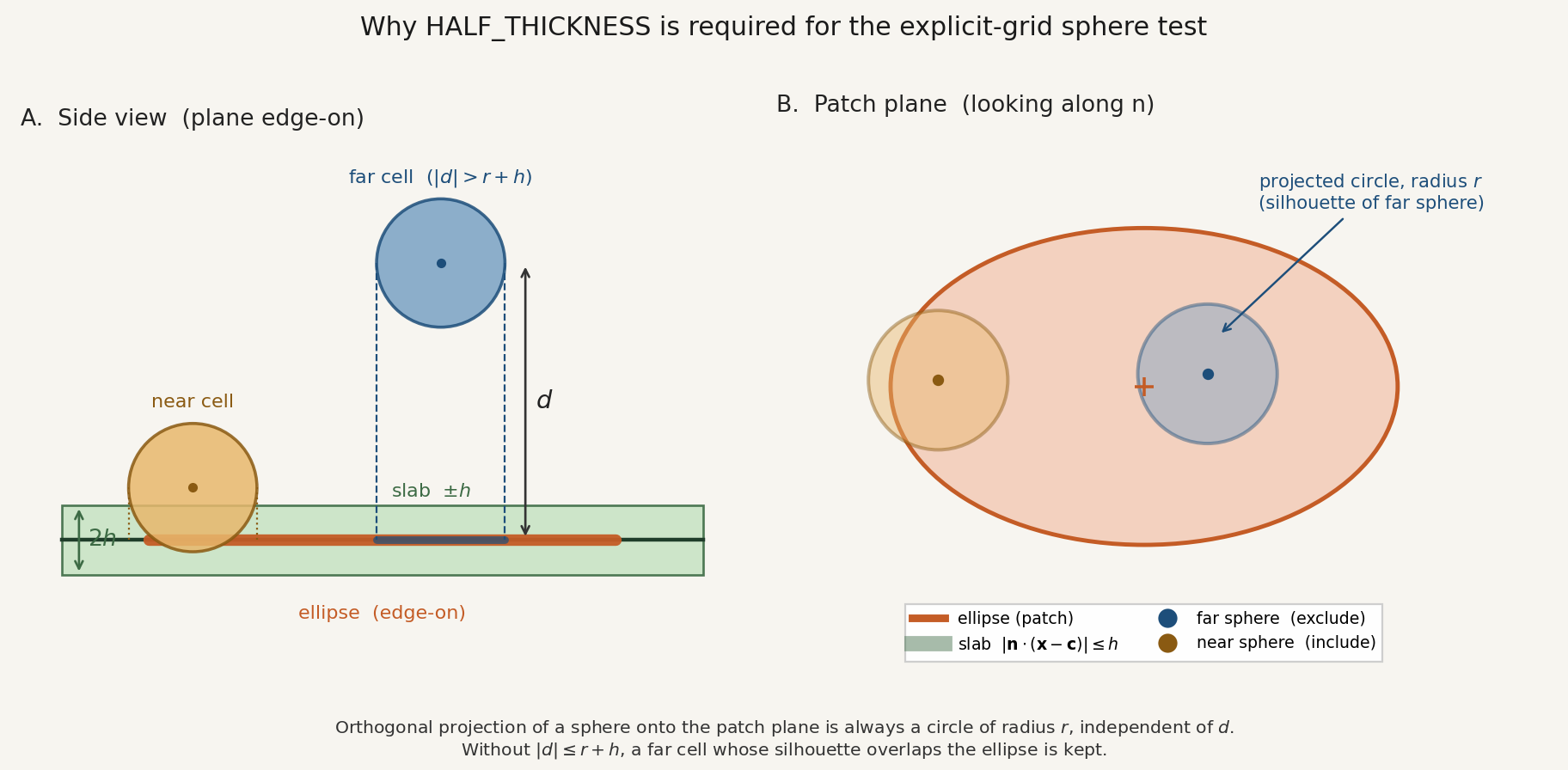
Explicit-grid sphere test. The orthogonal projection of a sphere onto the patch plane is always a circle of radius \(r\). The far cell (blue) never meets the slab of thickness \(2h\), but its silhouette overlaps the ellipse. The condition \(|d|\le r+h\) excludes it. The near cell (gold) meets both tests and is included.
Centroid filter
On structured and implicit grids a conservative circumsphere of radius \(R\) about the cell center is tested first. \(R\) is the hexahedral half-diagonal \(\tfrac12\sqrt{\Delta x^2+\Delta y^2+\Delta z^2}\) on structured meshes, or the maximum vertex–center distance on unstructured meshes. The cell is skipped (without clipping) if \(|d|>R+h\) or if the in-plane circle of radius \(R\) about the projected center misses the ellipse. This does not change the mapped set; it only avoids the polyhedron test for cells that cannot intersect the patch.
